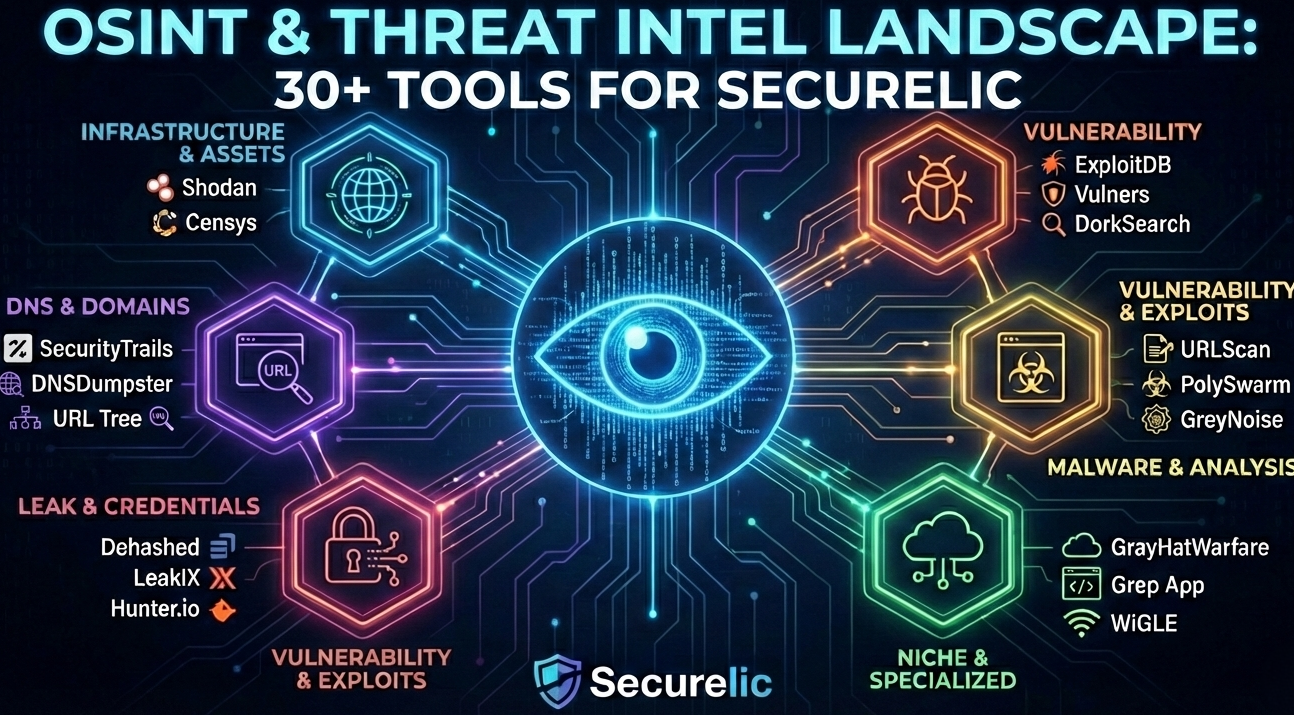
In the modern threat landscape, your defense is only as strong as your visibility. For security researchers and SOC analysts at Securelic, the ability to map an adversary's infrastructure or identify a leaked credential before it’s exploited is the difference between business as usual and a catastrophic breach.
Open Source Intelligence (OSINT) and Cyber Threat Intelligence (CTI) are no longer optional they are the backbone of proactive defense. Below is a curated technical breakdown of 30 platforms essential for attack surface management, credential audits and vulnerability research.
1. Infrastructure & Asset Discovery (The Global Scanner Tier)
Mapping the public facing footprint is the first step in any reconnaissance phase. These tools index the "living" internet.
- Shodan & Censys: The gold standards for finding IoT devices, industrial control systems and misconfigured servers via banner grabbing.
- ZoomEye & FOFA: Critical for cross referencing global assets, particularly effective for identifying regional infrastructure in Asia that Western scanners might miss.
- Netlas & BinaryEdge: Advanced scanners that provide high fidelity data on attack surfaces and exposed services.
- ONYPHE: A specialized "cyber defense search engine" that correlates scan data with threat information.
2. DNS, Domain & Certificate Intelligence
Attacker infrastructure often leaves a trail in the DNS records and SSL/TLS certificates.
- SecurityTrails: Unrivaled for historical DNS data. If a domain pointed to a malicious IP three years ago, SecurityTrails remembers.
- DNSDumpster: Excellent for rapid sub domain enumeration and mapping organizational infrastructure.
- crt.sh: Uses Certificate Transparency logs to find sub domains that haven't even been indexed by search engines yet.
- FullHunt: A modern attack surface tool designed to discover every asset a company owns across the entire internet.
This is a solid list essentially a "Who's Who" of digital reconnaissance. To make this rank well for Securelic while sounding like it was written by a battle hardened analyst rather than a bot, we need to move away from a simple list and toward a "Tactical Guide" format.
3. Credential Audits & Data Leak Intelligence
The most common entry vector is still stolen credentials. These platforms allow you to monitor for "pwned" data before hackers do.
- Dehashed & IntelligenceX: These are the heavy hitters for searching indexed data breaches. From clear text passwords to Tor hidden files, they cover the deep web.
- LeakIX: Specifically targets misconfigured databases (Elasticsearch, MongoDB) and exposed "dot env" files that leak API keys and secrets.
- Hunter.io: While often used for marketing, for a security pro, it’s a tool for mapping the internal email structures of a target organization.
4. Vulnerability Research & Exploit Development
Staying ahead of the "N day" exploit window requires real time vulnerability intelligence.
- ExploitDB & Packet Storm: The primary archives for verified exploits. If a PoC (Proof of Concept) exists, it’s here.
- Vulners: A massive, aggregated database that correlates CVEs with exploits, patches and social media mentions.
- DorkSearch: Automates "Google Dorking," making it easier to find sensitive files or admin panels indexed by Google.
5. Malware Analysis & Traffic Reputation
When you find a suspicious URL or file, you need to know its intent without executing it on your local machine.
- URLScan & PolySwarm: Great for sandboxing URLs to see their behavior and checking files against dozens of antivirus engines simultaneously.
- GreyNoise: This is crucial for "cutting through the noise." It tells you which IPs are scanning everyone (benign internet background noise) vs. which ones are targeting you specifically.
- Pulsedive: A community driven platform for analyzing Indicators of Compromise (IOCs) and threat actor tactics.
- AlienVault OTX: One of the largest open threat exchange communities for sharing real time threat data.
6. Niche & Specialized Intelligence
- GrayHatWarfare: The premier tool for searching public S3 Buckets often where the "real" data leaks happen.
- Grep App: Searches through millions of GitHub repositories. Perfect for finding hardcoded credentials or API keys leaked by developers.
- Wayback Machine: Digital forensics for the web. Useful for seeing what a site looked like before a breach or before evidence was deleted.
- WiGLE: A global database of wireless networks. Invaluable for physical red teaming and location based intelligence.
- PublicWWW: Allows you to search the source code of websites. Useful for finding sites running the same malicious script or tracking a specific hacker's signature.
The Securelic Perspective
While tools provide the data, Securelic provides the strategy. Using these 30 platforms in isolation is a start, but true security comes from correlating this data into an actionable defense plan.
Pro Tip: Start by automating your "Attack Surface Monitoring" using a combination of Shodan, crt.sh and LeakIX to ensure your own perimeter isn't the next one featured in a breach report.