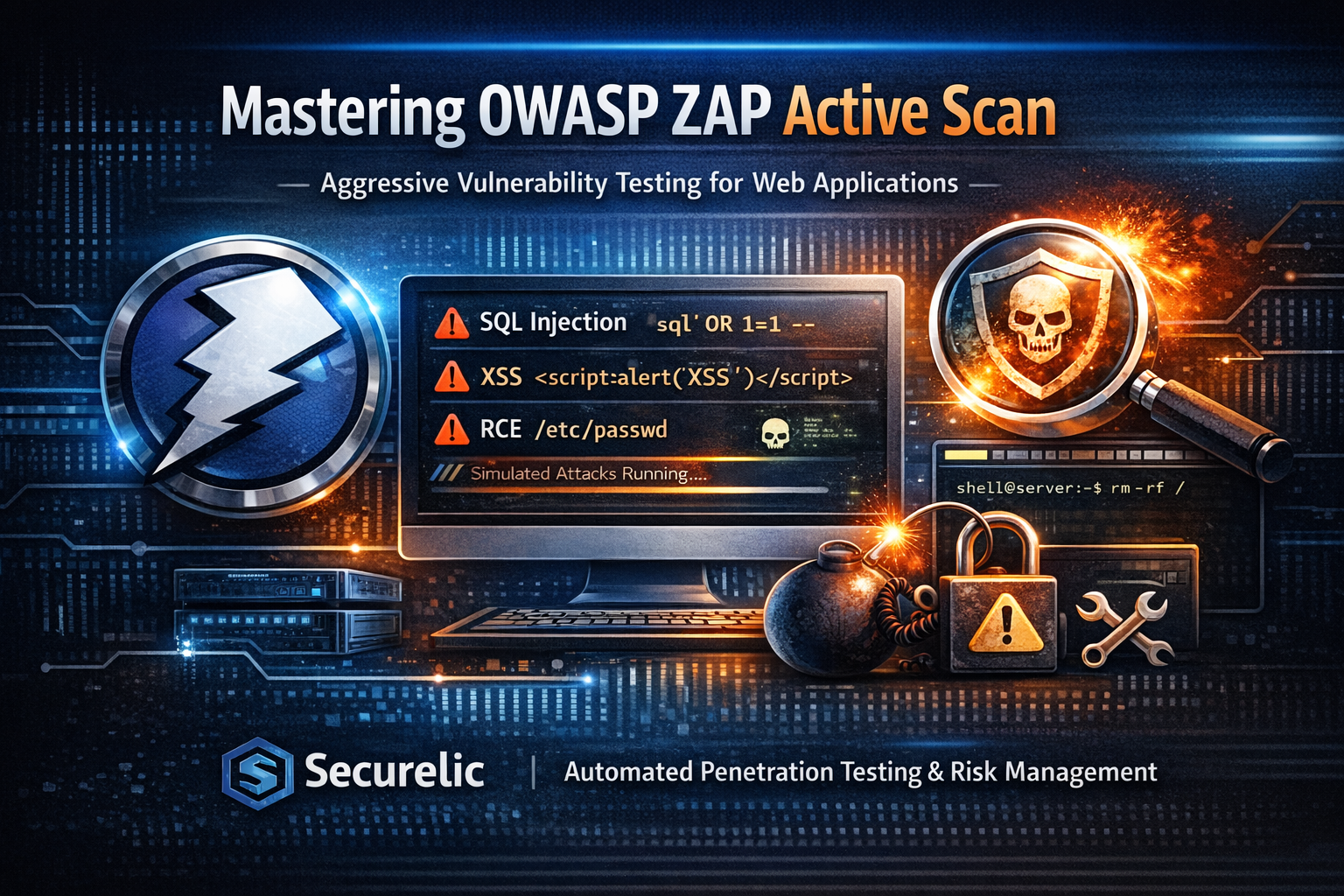
In the world of cybersecurity, being a silent observer is only half the battle. While passive scanning identifies surface level misconfigurations, true resilience requires a more rigorous approach. This is where OWASP ZAP Active Scanning comes into play.
By simulating real world attacks, active scanning allows security teams to identify deep seated vulnerabilities before a malicious actor does. In this guide, we’ll break down what active scanning is, its advantages and the critical vulnerabilities it uncovers.
What is OWASP ZAP?
As a refresher, the OWASP Zed Attack Proxy (ZAP) is the world’s most popular open source web application security scanner. It acts as a man in the middle proxy, enabling developers and security professionals to intercept traffic and test applications for a wide range of security flaws.
Defining Active Scan: The Proactive Approach
Unlike passive scanning which only looks at existing traffic an Active Scan is an automated attack against a specific target.
When you trigger an active scan, ZAP doesn't just watch; it talks. It generates and sends thousands of modified HTTP requests (payloads) to your application’s endpoints. It then analyzes the server’s responses to see if those payloads successfully bypassed security controls or caused unexpected behavior.
Security Note: Because active scans involve sending actual "attack" payloads, they can modify data or overwhelm a server. They should ideally be performed in staging or sandbox environments, rather than on live production data.
Why Use Active Scanning?
Integrating active scanning into your security workflow provides several key benefits:
- Deep Vulnerability Discovery: It reaches "blind spots" that passive observation cannot see, such as backend logic flaws.
- Validation of Risks: An active scan doesn't just say a field might be vulnerable; it attempts to prove it by executing a controlled exploit.
- Automation for DevSecOps: ZAP’s active scanner can be integrated into CI/CD pipelines, ensuring every new deployment is "stress tested" for security.
- Comprehensive DAST: It serves as a core component of Dynamic Application Security Testing (DAST), providing a real world perspective on your security posture.
Critical Vulnerabilities Identified by Active Scanning
OWASP ZAP’s active scanner is equipped with a vast library of attack scripts. Here are the primary flaws it excels at finding:
1. Injection Flaws (SQLi, Command Injection)
ZAP sends various escape characters and malicious queries (e.g., ' OR 1=1 --) to input fields. If the application returns database errors or unauthorized data, an injection vulnerability is flagged.
2. Cross Site Scripting (XSS)
By injecting <script> tags and other payloads into forms and URL parameters, ZAP checks if the application reflects these scripts back to the browser without proper sanitization.
3. Path Traversal & LFI
The scanner attempts to access sensitive system files (like /etc/passwd) by manipulating file paths in requests. This identifies whether an attacker could potentially read internal server files.
4. Remote Code Execution (RCE)
One of the most dangerous flaws, RCE allows an attacker to run arbitrary commands on your server. ZAP tests for various server side vulnerabilities that could lead to full system compromise.
5. Insecure Direct Object References (IDOR)
Active scanning helps identify if a user can access another user’s data by simply changing an ID value in the URL or request body.
Moving Beyond Manual Scans with Securelic
While OWASP ZAP is an incredible tool for individual developers, managing automated security at the enterprise level requires orchestration. Securelic takes the power of engines like ZAP and Nuclei to the next level by:
- Continuous Monitoring: Automating active scans across your entire attack surface.
- Prioritized Alerting: Filtering out noise and highlighting the most critical "exploit ready" vulnerabilities.
- Simplified Reporting: Turning complex scan logs into actionable insights for your engineering team.
By combining the offensive power of active scanning with the strategic oversight of an Attack Surface Management (ASM) platform, you ensure that your security keeps pace with your innovation.
References & Technical Deep Dive
To better understand the mechanics of automated penetration testing and active vulnerability research, we recommend the following resources:
OWASP ZAP Official Documentation: Active Scan Rules and Logic – Detailed breakdown of the attack vectors and payloads used by ZAP to identify vulnerabilities.
OWASP Top 10 Project: A03:2021 – Injection – The industry standard guide on why injection attacks occur and how active scanning prevents them.
Web Security Academy (PortSwigger): Cross Site Scripting (XSS) Analysis – An in depth look at XSS, one of the primary vulnerabilities discovered during active scans.
Automated Security at Scale: Explore Securelic’s DAST Solutions – Learn how we automate complex active scans to keep your attack surface secure 24/7.