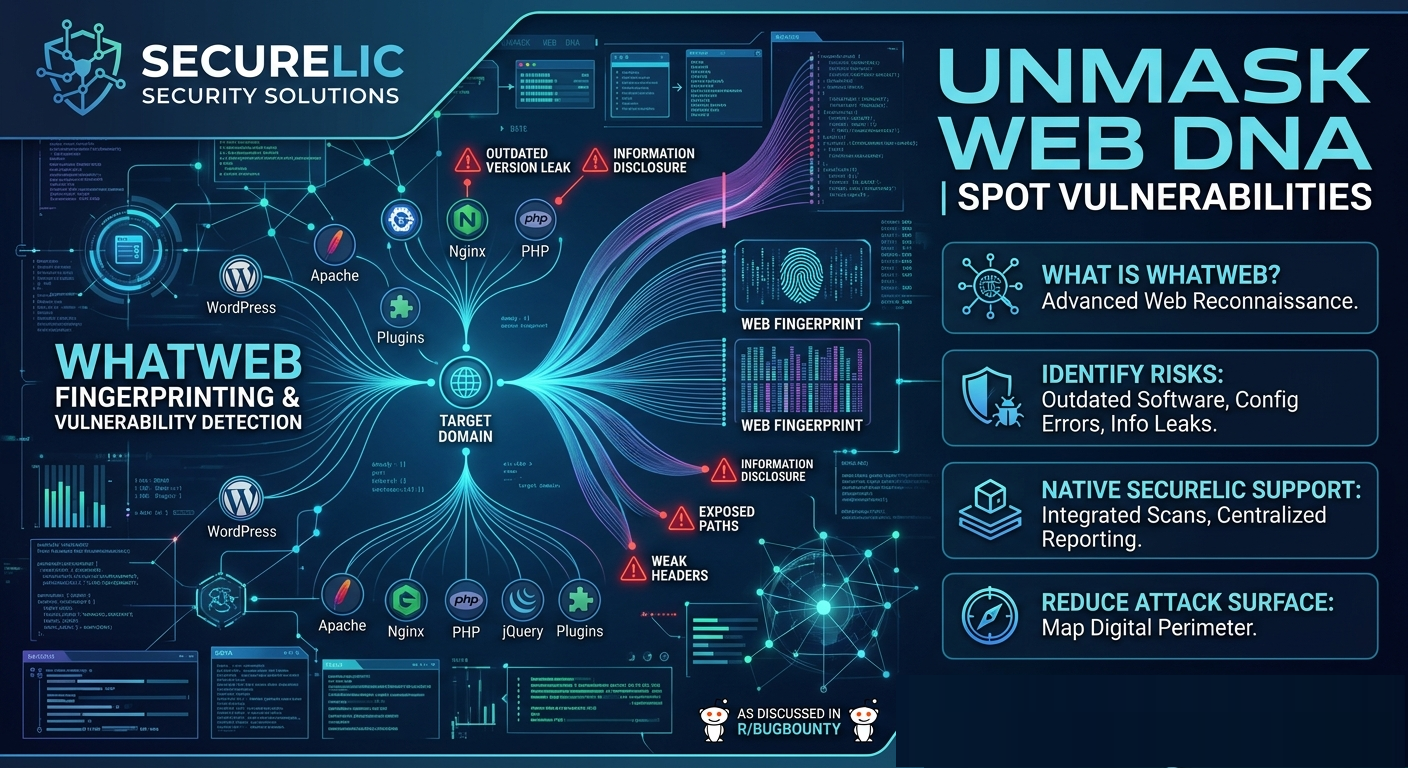
The Art of Web Recon: Mastering WhatWeb for Fingerprinting and Vulnerability Detection
In the high stakes world of cybersecurity, the phrase "You can't secure what you can't see" is the golden rule. Before a red teamer or a bug bounty hunter launches an exploit, they spend 80% of their time on reconnaissance. Among the top tier tools discussed in Reddit’s most active security communities (r/cybersecurity, r/bugbounty), WhatWeb stands out as the ultimate "fingerprinting" engine.
At Securelic, we understand that mapping your attack surface is the foundation of defense. That is why our platform offers full native support for WhatWeb, integrating its deep discovery capabilities directly into your automated security workflow.
What is WhatWeb?
WhatWeb is a next generation web scanner designed to identify the "DNA" of a website. It doesn't just check if a site is online; it identifies the underlying technology stack, including Content Management Systems (CMS), blogging platforms, JavaScript libraries, web servers, and even embedded devices.
With over 1,800 plugins, WhatWeb can pinpoint specific versions of software such as identifying a specific WordPress or Nginx build without requiring any internal access.
What Vulnerabilities Does WhatWeb Find?
While WhatWeb is primarily a reconnaissance tool, it is often the first tool to flag critical security risks. By identifying the specific technologies in use, it exposes:
- Version Leaks & Outdated Software: It detects outdated versions of platforms like Drupal, Joomla, or PHP. This allows you to identify assets affected by specific CVEs (Common Vulnerabilities and Exposures) before they are exploited.
- Information Disclosure: It flags sensitive HTTP headers (like
X-Powered-ByorServer) that leak backend environment details, providing a roadmap for attackers. - Misconfigured CMS & Exposed Paths: It can locate administrative interfaces, default configuration files, and "shadow" web services that should never be public facing.
- Third-Party Risk: It identifies third party scripts and libraries that may be vulnerable to supply chain attacks.
Why Vulnerability Management is Non Negotiable
The threat landscape has shifted. Attackers are now using Agentic AI and automated scripts to scan the entire IPv4 space for specific software versions within minutes of a new Zero-Day announcement.
If you aren't using tools like WhatWeb to see what your site is broadcasting, you are essentially leaving your front door unlocked. Proactive scanning ensures:
- Attack Surface Reduction: Closing unnecessary services and hiding identifying headers.
- Compliance Readiness: Meeting the rigorous scanning requirements for GDPR, SOC2, and PCI-DSS.
- Faster Remediation: Knowing exactly which assets need patching the moment a new vulnerability drops.
Securelic Standard: Native WhatWeb Integration
We don't just "support" WhatWeb; we have built it into the core of the Securelic ecosystem. Our platform automates the heavy lifting of reconnaissance so you can focus on remediation.
- Unified Dashboard: View all identified technologies and version-related risks in one centralized report.
- Automated Discovery: Schedule WhatWeb scans to run periodically, ensuring no new "shadow IT" or unmanaged assets pop up on your perimeter.
- The "Tools" Tab: You can trigger targeted WhatWeb scans directly from our Tools & Integrations tab to get an instant snapshot of any domain's technology stack.
Technical Reference & Resources
For a deeper dive into the technical execution of web fingerprinting and advanced scan levels, we recommend consulting these expert resources: