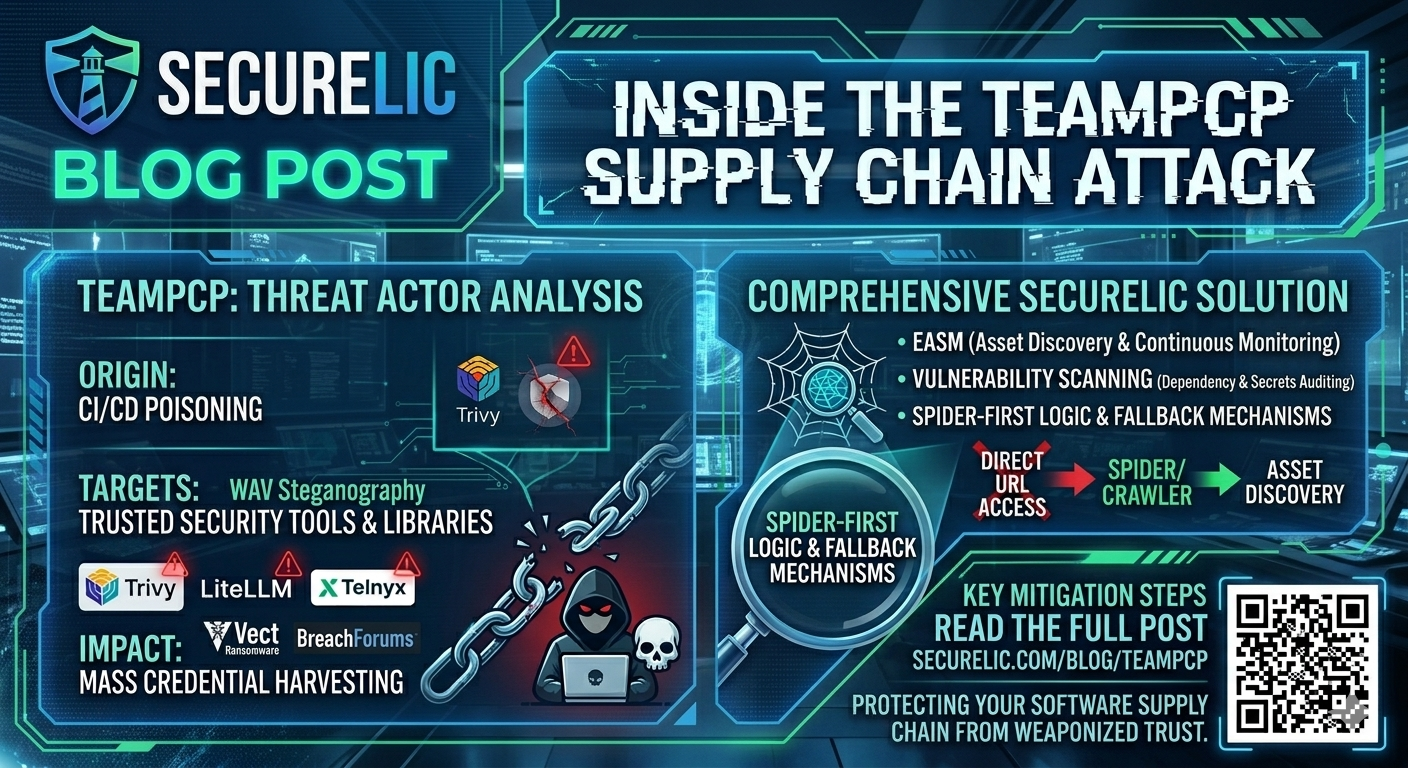
The TeamPCP Supply Chain Attack: When Security Tools Become Weapons
In March 2026, the cybersecurity landscape witnessed one of the most extensive and devastating software supply chain attacks to date. A threat actor known as TeamPCP weaponized trusted security tools and popular open-source libraries to launch a global credential-harvesting campaign.
This wasn't an isolated incident; it triggered a domino effect, spreading from system to system and ruthlessly exposing the blind spots in modern software development pipelines.
How the Attack Unfolded and Spread
The attackers utilized credentials stolen at each stage to exponentially expand their reach:
- Trivy and Checkmarx KICS (The Starting Point): The attack began by poisoning the CI/CD pipelines of Aqua Security's popular vulnerability scanner, Trivy. Credentials harvested from environments lacking version pinning were then used to pivot into Checkmarx GitHub Actions.
- LiteLLM (Expansion): Using the stolen CI/CD tokens, the attackers compromised the LiteLLM PyPI package, which boasts over 95 million downloads. The malicious payload injected into the package exfiltrated cloud credentials and environment variables (env) from thousands of unsuspecting developers.
- Telnyx and WAV Steganography (Deepening): Leveraging PyPI tokens obtained from the LiteLLM breach, TeamPCP bypassed GitHub entirely and directly injected malicious code into versions 4.87.1 and 4.87.2 of the popular communications SDK, Telnyx. Here, they utilized WAV steganography, hiding their malicious payloads within ordinary audio files to successfully evade traditional static analysis tools.
The Ransomware Partnership: The Real Threat is Just Beginning
A critical aspect of this attack is TeamPCP's partnership with Vect Ransomware and BreachForums to monetize their massive credential haul. The stolen data is being actively distributed to ransomware affiliates, paving the way for a wave of mass encryption and extortion targeting corporate networks globally.
Why External Attack Surface Management (EASM) is Critical
By nature, the threat in a supply chain attack often originates not from code your organization directly controls, but from a trusted third-party component. Minimizing the impact of such insidious attacks requires proactive and continuous asset discovery.
In modern vulnerability scanning architectures, it is far more effective to initiate active scanning with a comprehensive spidering approach rather than relying on a simple direct URL access (accessUrl) check. If this initial spider-led analysis fails to connect, an automatic fallback mechanism that triggers a subsequent spider call must be implemented to prevent the process from stalling. This ensures that forgotten or hidden endpoints on an organization's external network are continuously mapped, allowing toxic dependencies to be rapidly identified before they propagate across the infrastructure.