Why Are Web Vulnerabilities So Critical?
In today's interconnected digital landscape, web applications are the primary interface between businesses and their global users. However, they are also the most targeted attack vectors. Unpatched web vulnerabilities can lead to devastating data breaches, unauthorized server access and severe compliance violations.
Understanding and mitigating these risks is the core of External Attack Surface Management (EASM). Hackers continuously probe for weak points such as misconfigured headers, unvalidated inputs or outdated software components. Continuous, automated vulnerability scanning is no longer optional; it is a critical necessity to stay one step ahead of threat actors and secure your cloud infrastructure.
What is the Wapiti - Web Vulnerability Scanner? Core Features
The Wapiti Web Vulnerability Scanner is a highly effective, free and open source tool written in Python. Unlike static analysis tools that read source code, it performs comprehensive "black box" scans. It operates by crawling the deployed web application's pages extracting URLs, forms and inputs and then acts as a fuzzer, injecting payloads to uncover security flaws.
Standout Features:
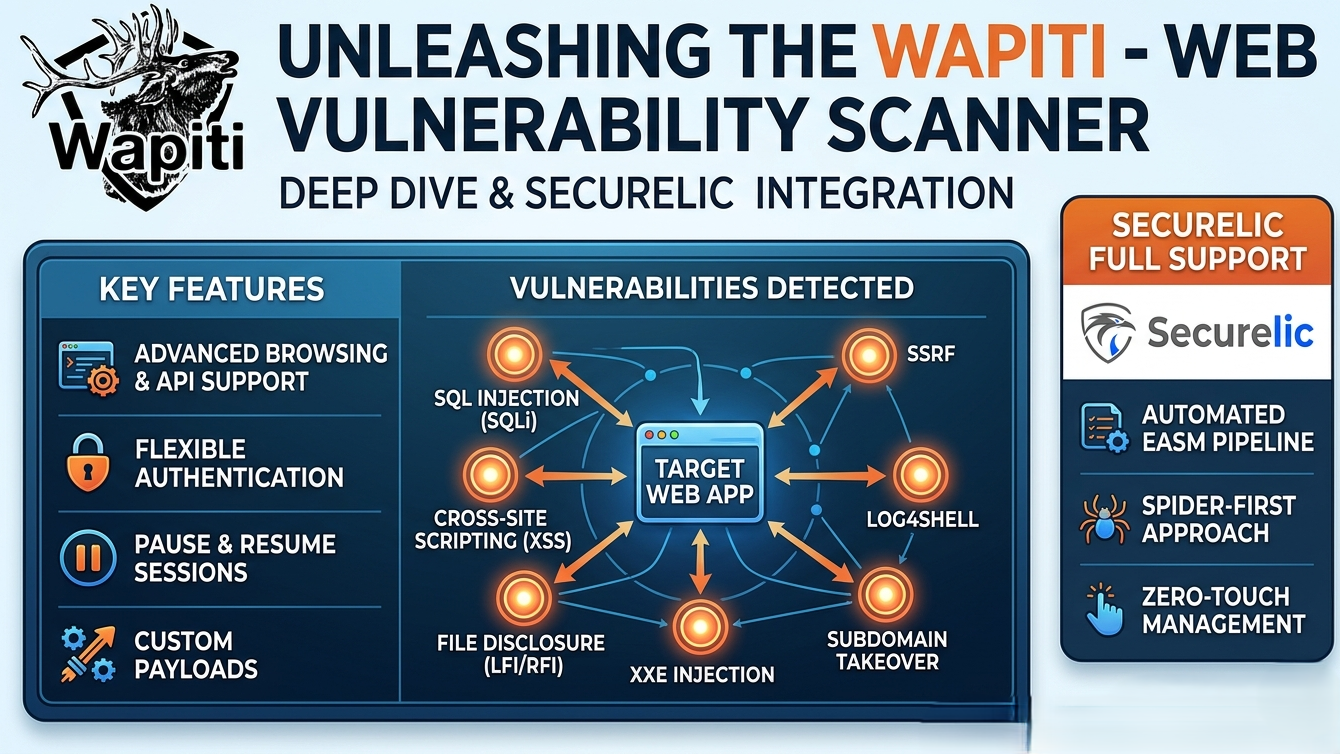
- Advanced Browsing & API Support: It automatically parses modern HTML5, extracts URLs from various files and natively supports automated API testing via Swagger/OpenAPI.
- Flexible Authentication: Supports Basic, Digest, NTLM and automated GET/POST login mechanisms.
- Session Management: Can pause and resume scan sessions natively, allowing for flexible audit scheduling without losing progress.
- Proxy & Payload Configuration: Offers robust SOCKS5/HTTP proxy support and makes adding custom payloads as easy as editing a text file.
What Vulnerabilities Does It Detect?
Its aggressive fuzzing modules cover a comprehensive list of critical web application security risks. By injecting specialized payloads, it reliably detects:
- Injection Flaws: SQL Injections (Error based, Boolean based, Time based), XPath Injections and XML External Entity (XXE) injections.
- Cross Site Scripting (XSS): Identifies both reflected and permanent (stored) XSS vulnerabilities.
- File & Command Execution: Uncovers Local/Remote File Inclusions (LFI/RFI) and Command Execution flaws (
eval(),system(), etc.). - Server Side Forgeries: Detects Server Side Request Forgery (SSRF) and basic Cross Site Request Forgery (CSRF).
- High Profile CVEs & Misconfigurations: Actively looks for Log4Shell (CVE-2021-44228), Shellshock, Subdomain Takeovers and TLS misconfigurations.
- Information Disclosure: Enumerates hidden folders (DirBuster style), searches for backup scripts, evaluates weak
.htaccessconfigurations and checks security headers/cookie flags.
Securelic Integration: Automated EASM
While it is a powerful command line application, managing individual CLI tools across a massive, dynamic cloud environment can become an operational bottleneck.
Securelic fully supports and integrates the Wapiti Web Vulnerability Scanner directly into its cloud based SaaS architecture. By bringing this engine into the Securelic ecosystem, security teams benefit from an automated, frictionless pipeline. Securelic enhances the tool's core capabilities by enforcing a strict spider first approach exhaustively crawling and mapping the web asset's topology before initiating the active payload injection phase. If direct endpoint access fails, the fallback spidering mechanism guarantees that the attack surface is still comprehensively discovered.
This deep integration allows users to harness raw fuzzing power alongside other industry standard engines, all orchestrated within Securelic's centralized dashboard for continuous, zero touch vulnerability management.